
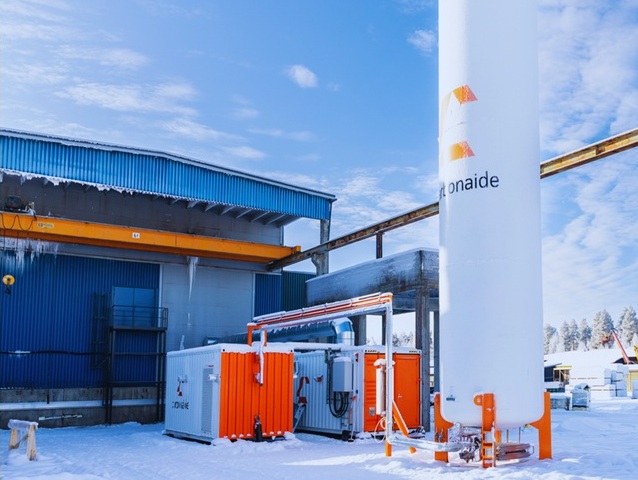
Concrete is the most widely used construction material in the world but also one of the largest sources of industrial carbon emissions. A major share of these emissions originates from the production of cement, the primary binding component of concrete. As the global construction sector expands, reducing the carbon footprint of building materials has become a central challenge for climate mitigation. New technologies are therefore emerging that aim not only to reduce emissions but to actively store carbon in construction materials.
Carbonaide, a Finnish cleantech company, develops technologies that utilize carbon dioxide during the curing phase of concrete production. The company’s process uses captured carbon dioxide during the curing phase of concrete production, mineralizing the gas into stable carbonates within the concrete structure. This chemical transformation is designed to mineralize and store carbon dioxide within the concrete while maintaining the mechanical performance of the products. By combining carbon storage with improved production efficiency, the approach aims to transform concrete manufacturing from a major emission source into a potential carbon sink.
Technology and Product
Carbonaide’s solution is based on a carbon dioxide curing process designed for precast concrete manufacturing. During the hardening phase, CO₂ is injected into sealed curing chambers where it reacts with minerals in the concrete and forms stable carbonate compounds. This mineralization process permanently binds the carbon within the material. The system operates at atmospheric pressure and can be integrated into existing concrete production facilities. Hardware modules manage the CO₂ flow and curing process, while a cloud-based monitoring platform monitors and verifies the amount of carbon stored in the products. In addition to storing carbon, the process can reduce cement usage and improve production efficiency, enabling manufacturers to produce lower-emission concrete elements with comparable structural performance.

Precast concrete elements produced using Carbonaide’s CO₂ mineralisation curing technology. (© Carbonaide)
Industrial Fit and Applications
The construction industry is responsible for a significant share of global greenhouse-gas emissions, creating strong demand for lower-carbon building materials. Technologies that enable carbon storage directly within construction products are therefore gaining increasing attention from manufacturers and policymakers. Carbonaide’s technology is currently mainly used for smaller precast concrete products such as pavers, blocks, and wall elements, with plans to expand toward larger precast elements and ready-mix concrete. Because the system integrates with existing curing chambers and production lines, manufacturers can adopt the process without major changes to plant infrastructure. By combining CO₂ utilization with reduced cement consumption, the technology allows concrete producers to lower emissions while main-taining product quality and production efficiency.

Digital monitoring system tracking the CO₂ curing process and carbon storage in concrete products. (© Carbonaide)
Founding Team
The company emerged from research at VTT Technical Research Centre of Finland, where scientists explored the use of carbon dioxide during the curing phase of concrete. Carbonaide was co-founded by Tapio Vehmas (CEO) and Jonne Hirvonen (COO). Building on this research background, the team combines expertise in materials science, concrete technology, and industrial process engineering to commercialise carbon-mineralisation technologies for the construction sector.

Carbonaide founders Jonne Hirvonen and Tapio Vehmas. (© Carbonaide)
Company Info

Carbonaide Oy
Address: Kauppakatu 25,
80100 Joensuu, Finland
Website: www.carbonaide.com
Title image © Carbonaide


You must be logged in to post a comment.